
The Book
The
SeaNet
Vision
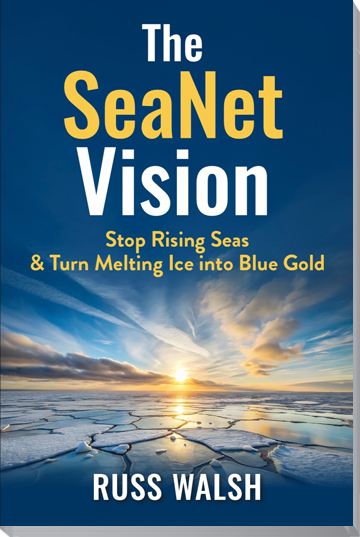
Coming April 2026: Russ’ highly anticipated book unveils the SeaNet Vision, a revolutionary strategy poised to redefine how the world confronts sea level rise—and unlock massive new economic and environmental possibilities.
And what if redirecting this emerging water source could reshape vast, underdeveloped regions into thriving, highly valuable land by 2070?
The SeaNet Vision is the story of a bold new way forward.
According to NASA:
- Sea levels could rise by 5 to 15 feet (nearly 2 to 5 meters) by the end of this century.
- If all the ice at the poles melted, the sea level could rise (again) by 230 feet (more than 70 meters).
- According to the World Ocean Review (WOR), More than a billion people worldwide currently live within 65 feet (20 meters) of mean sea level.
According to the World Ocean Review (WOR):
- More than a billion people worldwide currently live within 65 feet (20 meters) of mean sea level.
According to DW News—Asia:
- Indonesia is spending $33 billion to relocate its capital to a new city that will be safe from sea level rise.
SeaNet Vision breaks through conventional thinking on coastal resilience by aligning bold strategy with scientific rigor.
This book offers a comprehensive analysis of sea level rise, detailing the physical drivers, predictive modeling, and associated coastal risks. Notably, it explores innovative mitigation strategies, including large-scale water retention systems such as artificial inland lakes, as part of adaptive infrastructure planning. Its integration of engineering concepts with climate science makes it a valuable resource for resilience-focused research and policy development.
The SeaNet is a bold, audacious plan for a problem with few good solutions. The climate movement could use more fresh, unexpected ideas like it.
Russ Walsh’s book on Sea Level Rise is an important book on a critical topic. It is written in a manner that keeps your interest while being well documented and contains important new ideas. Highly recommended.
Walsh brings a very practical solution to dealing with this very real crisis, by proposing inland seas in remote arid areas, such as inland Australia, the Sahara Desert and Saudi Arabia.